
TL;DR:
- A decking warranty is a manufacturer’s guarantee that decks will meet specific performance standards for a set time. It covers structural integrity and cosmetic protection but often includes exclusions and prorated coverage, affecting resale value. Homeowners should register, understand the terms, and pair manufacturer warranties with contractor guarantees for effective protection.
A decking warranty is a manufacturer’s written guarantee that your boards will meet defined performance standards for a set period, covering structural integrity and cosmetic protection such as fade and stain resistance. Understanding why consider decking warranties matters before you spend money on an outdoor renovation. The right warranty protects your investment, supports your property’s resale value, and gives you a clear route to redress if something goes wrong. Deck Kingdom recommends reading every warranty document before you buy, not after.
Why consider decking warranties before you buy
A decking warranty is not just a piece of paper tucked into a product box. It defines exactly what the manufacturer will and will not fix, for how long, and under what conditions. Getting this clarity upfront saves you from expensive surprises years down the line.
Structural and fade warranties typically range from 25 to 50 years for premium composite decking. That sounds reassuring, but coverage is usually prorated after the first 5–10 years, meaning the manufacturer’s liability reduces progressively over time. Labour reimbursement is commonly capped and limited to the first 1–5 years of ownership.
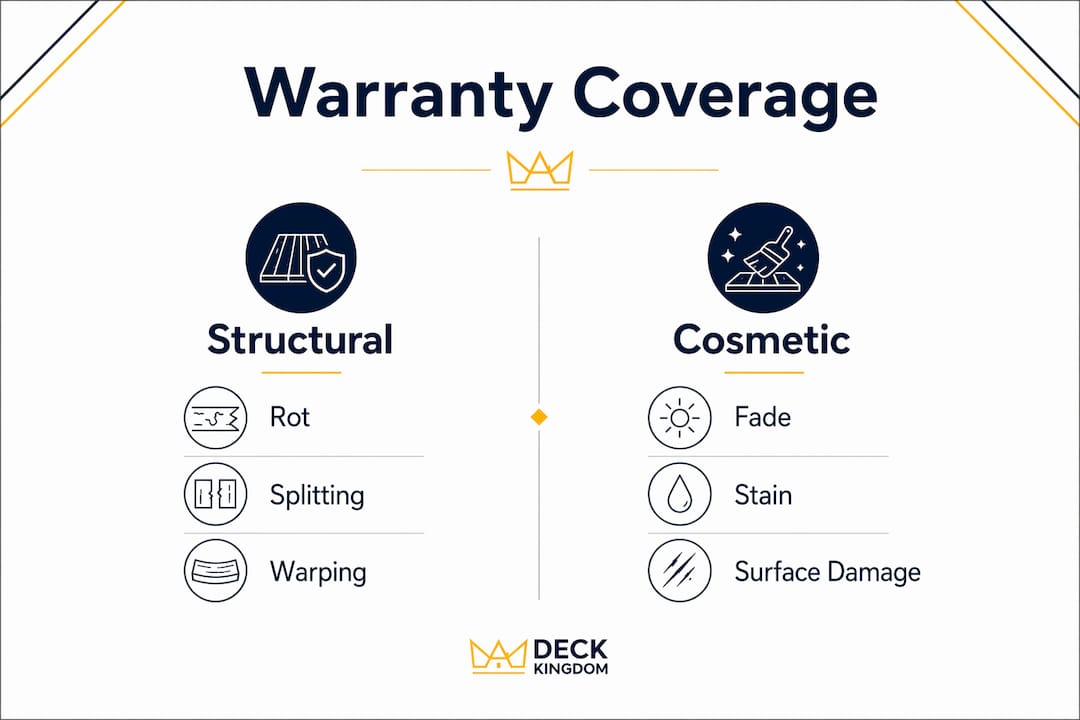
The two main categories of protection are structural warranties and cosmetic warranties. Structural warranties cover the board’s physical integrity: splitting, cracking, and rot. Cosmetic warranties cover appearance retention, specifically fade and stain resistance. Both types come with conditions you must meet to keep them valid.
Warranty transferability is a third dimension worth understanding early. A transferable warranty moves with the property when you sell, which directly affects buyer confidence and resale value. Not all warranties are transferable, and those that are often carry strict time limits.
What do decking warranties typically cover and exclude?
Coverage varies by manufacturer, but most composite decking warranties share a common structure. Knowing the standard inclusions and exclusions helps you compare products on equal terms.
What is usually covered
- Structural integrity: Protection against splitting, cracking, splintering, and rot for the full warranty term.
- Fade resistance: Cosmetic coverage for colour change beyond a defined threshold, measured using the Delta E colour shift scale.
- Stain resistance: Protection against permanent staining from household substances, subject to prompt cleaning conditions.
- Prorated replacement: Board replacement costs covered at a declining percentage after the initial full coverage period.
What is almost always excluded
- Installation errors and deviations from the manufacturer’s specification.
- Labour costs for removing and replacing defective boards.
- Damage from extreme weather events, flooding, or standing water.
- Normal surface wear from foot traffic and furniture.
- Mould or mildew resulting from inadequate maintenance.
The cosmetic side of warranty claims is harder to pursue than most homeowners expect. Fade and stain claims require professional measurement of colour change using the Delta E standard. This testing is technical and expensive, and many valid claims are denied because the measured shift does not cross the manufacturer’s threshold. The burden of proof sits firmly with you.
Pro Tip: Ask your supplier for the specific Delta E threshold written into the warranty before you purchase. If a manufacturer will not state it clearly, treat that as a warning sign.
Labour exclusions catch many homeowners off guard. Manufacturer warranties rarely cover labour for board removal and reinstallation. That means even if your boards are replaced free of charge, you pay the contractor to do the work. This is a significant hidden cost on larger decks.
How do decking warranties affect property value and resale potential?
A transferable warranty is one of the most underrated features in a decking product. When you sell your home, the new owner inherits the remaining coverage, which removes a layer of risk from their purchase decision.
Warranty transferability is typically limited to a single transfer within five years of the original purchase date. After that window closes, the warranty becomes non-transferable. Buyers who purchase a home outside that window receive no manufacturer protection, which weakens the deck’s contribution to the sale.
The financial impact is real. A transferable warranty can increase resale offers by approximately £5,000–£10,000, according to industry estimates. That figure reflects the buyer’s reduced risk and the perceived quality signal a long warranty sends. A deck without any remaining warranty coverage is simply a maintenance liability in a buyer’s eyes.
Transferable warranties enhance buyer confidence and make homes more attractive in competitive property markets. Buyers increasingly ask about warranty status during conveyancing, particularly for composite decking installations. Verifying the warranty status and requesting the original documentation should be standard practice for any buyer.
Key points to check when assessing a warranty’s resale value:
- Whether the warranty is transferable at all.
- The time window within which transfer must be registered.
- Whether the new owner must register the transfer with the manufacturer.
- Whether prorated coverage has significantly reduced the remaining value.
- Whether a workmanship warranty from the original contractor is still active.
What are the common misconceptions about decking warranties?
The biggest misconception is that a 25 or 50 year warranty means 25 or 50 years of full protection. It does not. Long-term warranties are frequently marketing tools with extensive exclusions, particularly for the most common real-world problems: UV fading, mould growth, and moisture damage. The headline figure attracts buyers; the fine print limits claims.
A second misconception is that professional installation is optional. Improper installation commonly voids manufacturer warranty coverage entirely. Deviations from the manufacturer’s specified fixing gaps, subframe requirements, or board orientation are enough to invalidate your claim. Some manufacturers require installation by an authorised contractor to maintain full coverage.
Pro Tip: Always request a written workmanship warranty from your contractor, covering a minimum of one year for installation defects. This fills the gap left by manufacturer warranties, which cover the product but not the person who fitted it.
A third misunderstanding involves the prorated structure. Many homeowners assume replacement boards are free throughout the warranty term. In reality, after the initial full coverage period (often 5–10 years), the manufacturer pays a declining percentage of the replacement cost. By year 20, the financial contribution from the manufacturer may be minimal.
Common pitfalls to avoid:
- Assuming “lifetime” means the life of your home, not the product’s rated lifespan.
- Skipping product registration and losing warranty activation.
- Failing to keep maintenance records, which manufacturers require as proof of compliance.
- Relying solely on the manufacturer warranty without securing a contractor workmanship guarantee.
- Not reading the exclusions section before purchase.
Manufacturers design warranties primarily as marketing tools rather than complete protection. Tempering your expectations and reading the fine print before signing off on a purchase is the most practical thing you can do.
How to make the most of your decking warranty
Getting full value from a warranty requires action at every stage of your project, from purchase through to ongoing maintenance.
-
Register your product immediately. Warranty coverage must be activated by registering the product with the manufacturer. Missing this step can void your coverage entirely, regardless of how well the deck is installed or maintained.
-
Follow the installation specification precisely. Use the manufacturer’s recommended fixing method, spacing, and subframe specification. Refer to a detailed composite decking installation guide to confirm you or your contractor are meeting every requirement.
-
Negotiate a written workmanship warranty with your contractor. Contractors recommend a separate workmanship warranty covering 1–5 years of installation defects. Get this in writing before work begins, not after.
-
Maintain the deck according to manufacturer guidelines. Regular cleaning, prompt stain removal, and seasonal checks are not optional extras. They are conditions of your warranty. Follow a structured composite decking maintenance routine suited to the UK climate.
-
Keep detailed records. Store your purchase receipt, installation photographs, product registration confirmation, and maintenance logs in one place. If you ever need to make a claim, this documentation is your evidence.
-
Understand the claims process before you need it. Read the warranty document now and note the claims contact, required documentation, and time limits for reporting defects. Acting too slowly after noticing a problem can disqualify your claim.
Pro Tip: When choosing decking boards, compare warranty terms side by side, not just the headline duration. Look at the prorated schedule, labour coverage, and transferability terms to get the true picture.
Key takeaways
A decking warranty’s real value lies in its specific terms, not its headline duration. Read the exclusions, register the product, and pair manufacturer coverage with a written workmanship warranty from your contractor.
| Point | Details |
|---|---|
| Warranty duration is prorated | Full coverage typically lasts 5–10 years; manufacturer liability reduces progressively after that. |
| Labour is rarely covered | Secure a written workmanship warranty from your contractor to cover installation and removal costs. |
| Transferability adds resale value | A transferable warranty can increase resale offers by approximately £5,000–£10,000 within the transfer window. |
| Registration is mandatory | Failing to register your product with the manufacturer can void your warranty entirely. |
| Cosmetic claims require testing | Fade and stain claims depend on Delta E colour measurements, making them technically difficult to pursue. |
Warranties in practice: what I’ve learnt after years in the decking industry
By Amanda Cheetham
The question I hear most often is: “Is the warranty actually worth anything?” My honest answer is yes, but only if you treat it as a framework rather than a safety net.
Most homeowners I speak with have never read their warranty document before installation begins. They discover the exclusions only when something goes wrong, which is the worst possible time. The prorated structure, the labour exclusions, the Delta E testing requirement for fade claims: none of these are hidden, but they are buried in language that rewards patience.
What I have found genuinely useful is pairing the manufacturer warranty with a contractor workmanship guarantee. The manufacturer covers the product; the contractor covers the fit. Together, they close most of the gaps. Without both, you have coverage that looks complete on paper but leaves real vulnerabilities.
The transferability angle is one that property managers in particular underestimate. A deck with a live, transferable warranty is a selling point you can quantify. A deck without one is simply an asset with an unknown maintenance liability. If you are managing multiple properties, tracking warranty status across your portfolio is worth the administrative effort.
My advice is straightforward. Read the document before you buy. Register the product the day it arrives. Photograph the installation. And never rely on a headline warranty term without checking the prorated schedule behind it. The industry is improving on transparency, but the responsibility still sits with you as the buyer.
— Amanda Cheetham
Deck Kingdom’s warranty-ready decking range
Choosing the right product is only half the equation. Getting the installation and aftercare right is what keeps your warranty valid for the long term.

Deck Kingdom supplies premium composite decking across the UK, with products backed by manufacturer warranties covering structural integrity and cosmetic performance. Every order comes with expert guidance on registration, installation requirements, and maintenance routines that keep your coverage intact. The how to fit composite decking tutorial walks you through each installation step in line with manufacturer specifications. Pair your boards with the right composite decking accessories to protect edges, maintain fixing integrity, and support long-term warranty compliance. Browse the full range at Deck Kingdom and get your project started with confidence.
FAQ
What does a decking warranty typically cover?
Most decking warranties cover structural defects such as splitting and rot, plus cosmetic issues including fade and stain resistance, for periods ranging from 25 to 50 years. Coverage is usually prorated after the first 5–10 years, and labour costs are almost always excluded.
Should I get a workmanship warranty alongside my manufacturer warranty?
Yes. Manufacturer warranties cover the product but not installation errors. A written workmanship warranty from your contractor, covering 1–5 years, protects you against fitting mistakes that would otherwise leave you with no recourse.
Does a decking warranty transfer to a new owner when I sell my home?
Many warranties allow a single transfer within five years of the original purchase date. After that window closes, the warranty becomes non-transferable, which can reduce the deck’s contribution to your property’s resale value.
How do I keep my decking warranty valid?
Register the product with the manufacturer immediately after purchase, follow the specified installation method precisely, and maintain the deck according to the manufacturer’s cleaning and upkeep guidelines. Keeping records of all maintenance activity is also required for most warranty claims.
Why are fade and stain warranty claims so difficult to make?
Fade and stain claims require professional measurement of colour change using the Delta E standard. This testing is costly and technical, and many claims are rejected because the measured colour shift does not exceed the manufacturer’s defined threshold.
