
The dominant exterior surface trends for 2026 centre on biophilic textures, warmer earth-tone palettes, matte and tactile finishes, low-maintenance durable materials, and invisible smart features that disappear into the design.
What this means for you at a glance:
- Homeowners: swap cool grey for mushroom, taupe, or sage and choose composite or porcelain for surfaces you will actually use in January.
- Designers: colour drenching is moving from interiors to facades — but dark tones require solar-reflective formulations.
- Installers and specifiers: frost rating, R11 slip resistance, and correct sub-base specification are non-negotiable for any trend-led surface to perform through a UK winter.
What is driving exterior surface trends in 2026?
Several forces are converging at once, and understanding them helps you judge which directions will last beyond a single season.
Year-round outdoor living is the biggest single driver. Garden designers now treat the garden as a genuine extra room, which pushes material choices toward surfaces that look good in February as well as August. Purposeful zoning — a dining area, a lounging zone, a planting border — demands materials that can handle foot traffic, standing water, and frost without looking tired.
Biophilic design is steering specifiers away from smooth, reflective surfaces toward organic textures and matte finishes. The goal is an exterior that reads as established and loved rather than freshly installed. Natural stone looks, wood-grain composites, and hand-textured renders all serve this instinct.
Maintenance and cost-of-ownership pressure is real. Homeowners and landlords alike are choosing materials with longer service lives and lower annual upkeep, which is why porcelain paving, composite decking, and silicone thin-coat renders are all gaining ground over painted timber or standard concrete.
Sustainability and circular procurement are moving from aspiration to specification requirement. Architects and developers are asking for recycled content data, embodied carbon figures, and end-of-life plans. Cedral’s survey of 250 architects and installers found that 96% say climate change is affecting their facade design and specification choices.
Invisible smart technology rounds out the picture. Concealed LEDs, automated irrigation, and hidden sensors are becoming standard rather than optional extras.
- Warm earth-tone palettes previewed by major render and paint brands signal a clear shift away from cool grey.
- Large-format porcelain and next-generation composite materials are appearing in supplier trend reports as the go-to low-maintenance choices.
- Smart integrations are specified to be hidden, not showcased.
Pro Tip: If you are specifying a dark facade colour, ask your render or coating supplier for the Total Solar Reflectance (TSR) value. Dark, colour-drenched surfaces without solar-reflective pigment technology can reach surface temperatures 10–15°C higher than lighter equivalents, causing expansion-related cracking and debonding over time.
What is trending surface by surface in 2026?
Driveways and paving
Large-format porcelain slabs are the headline choice for modern driveways and patios, valued for their low porosity, frost resistance, and near-zero maintenance. Porcelain and contemporary concrete are popular for creating visual continuity between interior floors and outdoor spaces. Resin-bound drives are also growing, particularly in warmer tones like buff and sandstone that complement the earth-tone palette shift.
There is a notable sizing polarity in 2026: large slabs and small-format cobbles are both rising, one for a minimal modern flow, the other for a retro cobbled character. Permeability matters too — check whether your local authority requires a permeable surface for front drives under permitted development rules.
Decking
Composite decking is the clear trend material for 2026. It delivers the wood-grain aesthetic that biophilic design demands while requiring only a seasonal wash rather than annual sanding and staining. Next-generation Enhanced Fibre Composites (EFC) with mineral reinforcement outperform traditional Wood Plastic Composites (WPC) in dimensional stability and moisture immunity, allowing tighter joint tolerances and longer service life in UK conditions. You can explore the latest composite decking trends for a full breakdown of colours and board profiles.

Cladding and render
Earth-tone colour drenching is the defining cladding story this year. Silicone thin-coat render systems in mushroom, taupe, and warm clay are replacing painted finishes because they are more breathable, more durable, and far easier to clean. Fibre cement cladding is gaining ground as a retrofit choice, particularly for upgrading tired timber facades. A ventilated facade system improves energy efficiency by enabling rapid drying of external walls and reducing condensation.
Tiles and large-format slabs
Matt, tactile textures dominate the tile category. Natural stone looks in large formats (600 mm × 600 mm and above) are popular for terraces and rooftop installations, often specified on pedestal raised systems that improve drainage, allow modular access for maintenance, and speed up installation.
Fences and balustrades
Black and anthracite accents are the standout colour story for boundary treatments. Composite fencing in these tones provides year-round privacy without the warping, splitting, or repainting that timber demands. Integrated balustrade solutions in matching profiles are popular for raised decks and terraces, creating a cohesive look. For current fence design directions, the move toward darker, slimmer profiles is consistent across the UK market.
Windows and doors
Bronze, deep green, and soft beige frames are replacing the anthracite grey that dominated the previous decade. Statement pivot doors with integrated LED lighting or biometric locks are a growing specification choice, particularly in new builds and high-end renovations. Larger glass areas with slimmer frames are popular where building regulations and, in conservation areas, planning consent permit them.
Exterior lighting and smart features
The most effective smart integrations are those that disappear visually. Concealed low-glare LEDs set into paving joints or deck boards, automated irrigation triggered by soil sensors, and hidden security cameras are all being specified as standard rather than afterthoughts. The design brief is a magical night-time environment with no visible fixtures cluttering the daytime view.
Pro Tip: Plan lighting cable runs and irrigation pipe routes before laying any hard surface. Retrofitting concealed services through finished paving or decking is expensive and disruptive.
| Surface | Best for | Durability / lifespan | Maintenance level | UK climate suitability | Typical cost range | Sustainability credentials | Visual style |
|---|---|---|---|---|---|---|---|
| Composite decking is suitable for year-round outdoor living and informal gardens, offering high durability and low maintenance with frost-rated, slip-resistant grooved boards and warm, wood-grain matte tones. | |||||||
| Large-format porcelain is great for high-traffic patios and formal kerb appeal, providing long-lasting, low-maintenance, frost-resistant surfaces with matte or polished stone looks. | |||||||
| Resin-bound drives suit driveways and permeable front gardens, offering permeable, UV-stable surfaces with low maintenance in warm buff and sandstone tones. | |||||||
| Silicone thin-coat render is used for facades and colour drenching, providing breathable, crack-resistant finishes with low maintenance in matte, fine-textured earth tones; solar-reflective technology is recommended for dark colours. | |||||||
| Composite fencing offers privacy and boundary definition with frost- and UV-stable, low-maintenance, recycled-content boards in anthracite, black, and muted tones. | |||||||
| Clay pavers suit formal paths and heritage settings, providing long-lasting, frost-resistant surfaces with low maintenance in traditional, earthy tones. |
What colours and textures define 2026 exteriors?
The palette shift is the most immediately visible change in 2026. Cool grey, which dominated UK exteriors for the better part of a decade, is giving way to warmer neutrals. Renders World identifies five dominant directions: mushroom, taupe, soft terracotta, warm clay, and muted sage. Each works differently depending on context.
Mushroom and taupe are the safest choices for most UK homes. They read as neutral in flat northern light but pick up warmth in direct sun, which means they look good year-round. They pair well with dark anthracite trims and natural timber accents.

Soft terracotta and warm clay suit south-facing facades and garden walls where the richer tone can develop properly. On north-facing walls, they can look muddy, so test a sample in the actual light conditions before committing.
Muted sage is the standout choice for garden buildings, fences, and outbuildings. It sits naturally against planting and reads as contemporary without being stark.
On texture, the direction is firmly toward matte and tactile. Fine-grain coatings (around 1.5–2 mm grain size) are preferred over smooth finishes because they hide minor surface imperfections, age more gracefully, and reduce glare. Soft-textured coatings also tend to perform better in wet conditions because they allow the surface to breathe.
- Layered tone-on-tone systems are the most successful approach for UK homes. Body colour, trim, and door colour are chosen from the same tonal family at different depths, rather than sharp contrasts.
- FacadeColorizer’s analysis of thousands of colour previews found that 73% of homeowners change their initial colour choice after previewing it on their actual property, which is a strong argument for ordering physical samples before purchasing.
- Conservation area properties should lean toward the mushroom and taupe end of the palette, as these tones are most likely to satisfy local planning officers looking for materials that respect the existing street scene.
How do you specify surfaces that perform in the UK climate?
Trend-led choices only work if the technical specification is right. A beautiful matte porcelain terrace that cracks after the first hard frost, or a dark render that debonds because it lacks solar-reflective pigment, will cost far more to fix than the saving made by skipping the specification checks.
Critical performance measures to check:
- Slip resistance: R11 rating for any surface likely to be wet underfoot (pool surrounds, steps, shaded patios). R10 is acceptable for most general patio use.
- Frost resistance: look for BS EN 12670 compliance for stone and porcelain, and confirm the product is rated for external UK use.
- UV and fade warranty: composite decking and coloured renders should carry a minimum 10-year fade warranty. Ask for the specific test standard used.
- TSR / solar-reflective pigment: mandatory for any dark facade colour. Ask for the TSR value in writing.
For weatherproof composite decking, correct sub-base specification and expansion gap allowances are as important as the board choice itself.
Seasonal maintenance schedule
| Material | Spring | Summer | Autumn | Winter |
|---|---|---|---|---|
| Composite decking | Wash boards, check clip fixings | Spot-clean as needed | Clear leaf debris, check drainage channels | No action needed |
| Porcelain paving | Wash with pH-neutral cleaner | Spot-treat stains | Clear organic debris | Check for frost-lifted joints |
| Silicone render | Inspect for cracks, clean if algae present | No action needed | Check sealant around openings | No action needed |
| Resin-bound drive | Jet wash, check edges | Spot-treat oil stains | Clear leaves promptly | No action needed |
Sustainability checklist:
- Ask for recycled content percentage by weight.
- Request embodied carbon data (kg CO₂e per m²) for any major surface material.
- Check whether the product is covered by a producer take-back or recycling scheme at end of life.
- Prefer materials with third-party environmental product declarations (EPDs) over self-certified claims.
- For cladding, fibre cement products use fewer raw materials and less energy in manufacture than some traditional alternatives, and support circularity through carbonation.
How do you choose the right surface for your project?
Work through these steps before you contact a supplier or installer.
- Define the use case. Is this a high-traffic driveway, a sheltered dining terrace, a north-facing side return, or a raised rooftop deck? Each has different slip, frost, and drainage requirements.
- Assess your maintenance appetite honestly. If you will not sand and oil timber annually, do not specify timber. Composite and porcelain require far less effort.
- Set a realistic budget. Include supply, sub-base preparation, installation labour, and fixings. Surface material cost is typically 40–60% of the total installed price.
- Decide on a lifespan target. A 10-year rental property refurbishment has different material priorities than a forever-home garden.
- Check sustainability requirements. Some commercial projects now require EPD data at tender stage.
- Order samples before you commit. View them on the actual surface, in the actual light, at different times of day.
Questions to ask your supplier or installer:
- What is the frost resistance rating and which standard was it tested to?
- What slip resistance rating does this product carry, and is it appropriate for my use?
- What sub-base specification do you recommend, and will you provide it in writing?
- What are the expansion joint tolerances, and how are they managed?
- What does the warranty cover, and who administers it?
- Can you provide a material spec sheet and, for coloured surfaces, a TSR value?
A supplier who cannot answer these questions clearly is a red flag. Walk away from any installer who dismisses sub-base specification as unnecessary or cannot produce a written warranty.
For a full 25-year durability specification guide, Deck Kingdom’s buyer resource covers lifespan expectations and warranty benchmarks in detail.
Budget and timeline ballparks for common UK projects:
- Composite deck (40 m²): supply and installation typically 4–8 weeks from order to completion, depending on sub-frame complexity.
- Porcelain patio (30 m²): 2–4 weeks, including sub-base preparation.
- Silicone render (front facade): 1–2 weeks for a standard semi-detached, weather permitting.
- Resin-bound driveway (50 m²): 1–2 days installation once sub-base is prepared.
Why composite decking from Deck Kingdom fits 2026 trends
Composite decking sits at the intersection of every major 2026 direction: biophilic wood-grain texture, low maintenance, frost and slip resistance, and recycled content credentials. Deck Kingdom supplies composite boards, cladding, fencing, balustrades, artificial grass, and all the accessories and fixings you need for a complete outdoor project, with free samples, nationwide delivery, and a Manchester showroom for click-and-collect.
Pro Tip: When choosing between WPC (Wood Plastic Composite) and EFC (Enhanced Fibre Composite) boards, go for EFC if your deck will be exposed to prolonged moisture or temperature swings. EFC’s mineral reinforcement gives tighter joint tolerances and better long-term dimensional stability, which matters on a UK deck that sees both July heat and January frost.
| Dimension | Composite decking (typical) |
|---|---|
| Best for | Year-round outdoor living, informal gardens, raised terraces |
| Durability / lifespan | 25+ years with correct installation |
| Maintenance level | Low: annual wash, no sanding or oiling |
| UK climate suitability | Frost-rated, grooved slip-resistant surface, UV-stable |
| Typical cost range | £30 per m² supply |
| Sustainability credentials | Recycled wood fibre and plastic content; no annual chemical treatment |
| Visual style | Wood-grain matte finish; warm tones including grey-brown, charcoal, teak |
For installation, the key specification points are: allow a minimum 5 mm expansion gap between board ends and any fixed structure; use hidden clip fixings at the correct spacing for your board profile; ensure the sub-frame is level and ventilated; and use frost-rated composite end caps to finish exposed board ends cleanly. Deck Kingdom’s composite decking installation tutorial walks you through each stage with photographs and measurements.
For composite board durability metrics and homeowner-facing explanations, Deck Kingdom’s guide covers what to expect at 5, 10, and 25 years.
Do new surface trends work in conservation areas?
This is one of the most practical questions for UK homeowners, and the answer is: often yes, with the right material and colour choices.
Conservation area consent and listed building consent rules vary by local authority, but the general principle is that new materials should be sympathetic to the existing character of the area. The good news is that the 2026 palette directions, mushroom, taupe, warm clay, and muted sage, are inherently more sympathetic to traditional British streetscapes than the cool grey and stark white that preceded them.
Key points to check before specifying:
- Front garden hard surfacing over 5 m² that is not permeable requires planning permission in most cases, regardless of conservation area status. Resin-bound and permeable block paving avoid this requirement.
- Replacement windows and doors in conservation areas usually require planning consent, even if they would be permitted development elsewhere. Bronze and deep green frames are generally viewed more favourably than stark white uPVC, but always confirm with your local planning authority before ordering.
- Cladding and render changes to the principal elevation of a property in a conservation area typically require consent. Silicone thin-coat renders in earth tones have been approved in many conservation areas because they can be applied at a thickness that matches existing render profiles.
- Reclaimed stone, clay pavers, and British limestone such as Purbeck are frequently specified in conservation settings because they offer authentic texture and a reduced carbon footprint from local sourcing.
The practical advice is to approach your local planning authority with a sample board and a written material specification before committing to purchase. Most conservation officers respond positively to applicants who demonstrate they have thought carefully about material compatibility.
Key takeaways
The single most important action for any 2026 exterior project is to match your material choice to your climate exposure and maintenance reality before you fall in love with a colour.
| Point | Details |
|---|---|
| Palette shift is confirmed | Warmer earth tones (mushroom, taupe, sage, terracotta) are replacing cool grey across facades, decking, and fencing. |
| Dark colours need TSR protection | Solar-reflective pigment is required for dark renders and coatings to prevent surface temperatures rising by 10–15°C and causing cracking. |
| Slip and frost ratings are non-negotiable | Specify R11 slip resistance for wet areas and confirm frost resistance to BS EN 12670 for any external stone or porcelain. |
| Sample before you commit | 73% of homeowners change their initial colour choice after previewing it on their property; always order physical samples first. |
| Deck Kingdom for composite supply | Deck Kingdom supplies composite decking, cladding, fencing, and balustrades with free samples and nationwide delivery for UK projects. |
Style versus durability: finding the right balance in 2026
The conversation I keep having with homeowners and designers this year is about the gap between what looks beautiful in a mood board and what actually holds up after three UK winters. The 2026 palette directions are genuinely exciting, and the move toward warmer, more textured surfaces is long overdue. But the risk is that people chase the aesthetic without doing the technical groundwork.
The most common mistake is specifying a dark, colour-drenched facade without asking for the TSR value. The second most common is choosing a smooth, polished porcelain tile for a shaded north-facing patio because it looks elegant, then discovering it is a slip hazard by November. Neither of these is a trend problem. Both are specification problems.
For conservation area projects, the 2026 palette is actually an opportunity. Mushroom and taupe reads as far more sympathetic to Victorian and Edwardian streetscapes than the stark white render or anthracite grey that planning officers have been pushing back on for years. The texture direction, matte, fine-grain, hand-finished, also aligns well with the character of older buildings. You can follow the trend and satisfy your conservation officer at the same time, provided you choose the right product and present it properly.
Deck Kingdom: your source for trend-aligned outdoor materials
If you are ready to move from planning to purchasing, Deck Kingdom gives you a direct route to the composite decking, cladding, fencing, balustrades, and artificial grass that sit at the heart of 2026’s outdoor living direction. You get free samples sent to your door, nationwide delivery, and a Manchester showroom if you prefer to see boards in person before ordering.
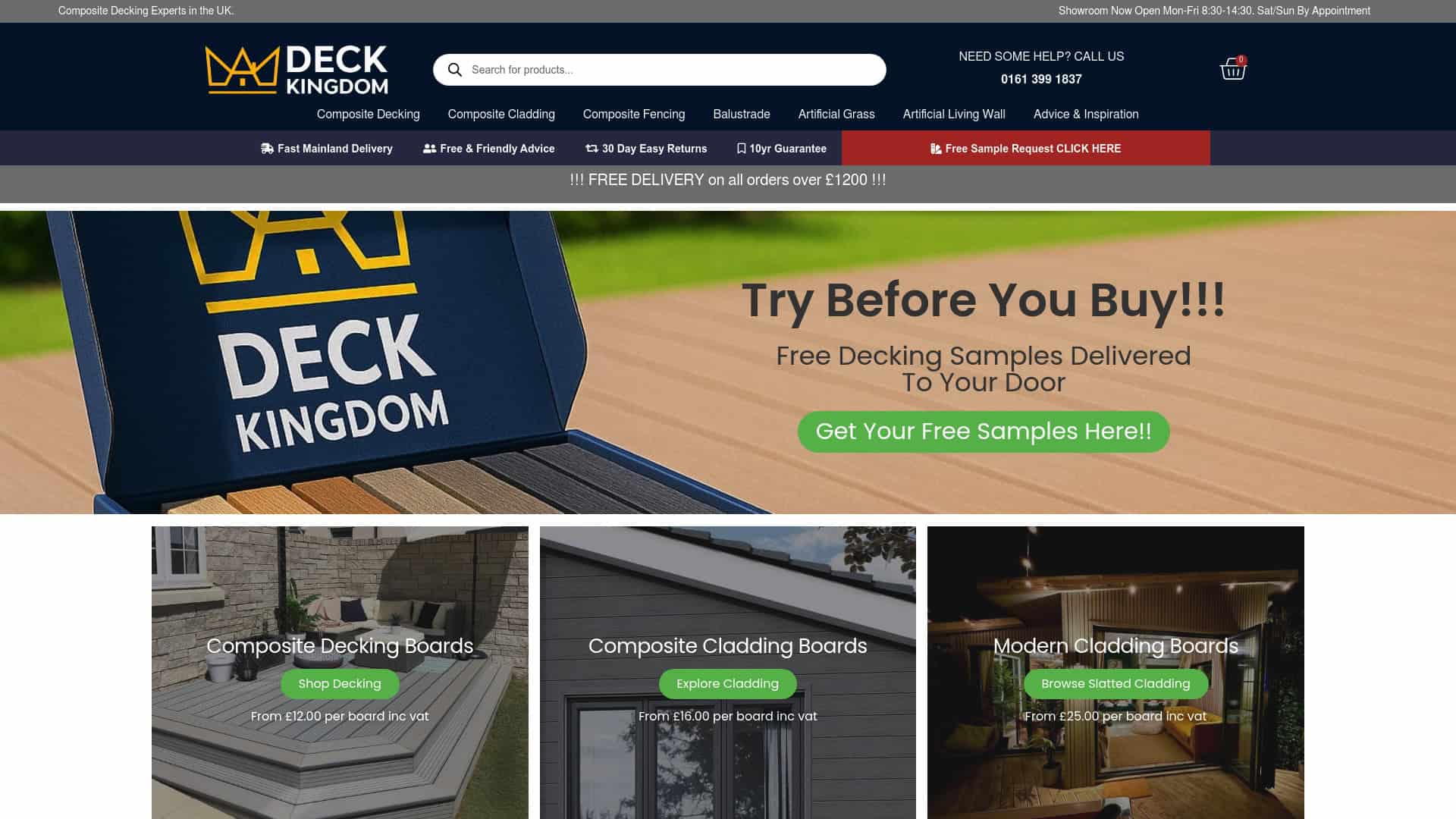
The practical starting points are straightforward. Browse the full range of composite decking accessories for clips, trims, and fixings that complete a professional finish. If fencing is on your list, the composite fencing range covers the pros, cons, and product options in detail. For a complete project overview, the outdoor renovation checklist walks you through every stage from sub-base to finishing trim.
Request a free sample pack at deckkingdom.co.uk to see the colours and textures in your own garden light before you commit to an order.
Useful sources for UK specification and further reading
- Garden and hardscaping trends for 2026 — Miles Stone: practical designer commentary on year-round outdoor living and material choices for UK gardens.
- 2026 render colour trends UK — Renders World: detailed palette directions and technical guidance on solar-reflective formulations for dark renders.
- Paving and landscaping trends for 2026 — RF Paving: covers pedestal systems, smart integrations, and sizing trends for patios and terraces.
- Garden trends 2026 — Marshalls: supplier perspective on porcelain paving and contemporary concrete for indoor-outdoor continuity.
- Cedral fibre cement facades — BPindex blog: survey data on climate-driven facade specification and fibre cement sustainability credentials.
- Materials garden designers are using in 2026 — Miles Stone: covers reclaimed stone, clay pavers, and British limestone with sustainability and durability notes.
- Exterior wall paint colour combination UK 2026 — FacadeColorizer: data on colour preview behaviour and the case for layered tone-on-tone systems.
- Top decking trends for 2026 — Deck Kingdom: product and colour guidance for composite decking in the UK, including material comparisons and installation notes.
FAQ
What are the main exterior design trends for 2026?
The headline directions are biophilic textures, warmer earth-tone palettes (mushroom, taupe, sage, soft terracotta), matte and tactile finishes, low-maintenance composite and porcelain surfaces, and invisible smart features such as concealed LEDs and automated irrigation.
What surface patterns and textures are trending in 2026?
Matte, fine-grain textures in the 1.5–2 mm range are preferred over smooth or polished finishes. Large-format slabs and small-format cobbles are both popular, offering a choice between a minimal modern flow and a traditional cobbled character.
What outdoor flooring is most popular in 2026?
Large-format porcelain paving and composite decking are the two standout choices for UK gardens in 2026, valued for their low maintenance, frost resistance, and ability to create visual continuity between indoor and outdoor spaces.
What is the biggest home exterior trend in 2026?
Year-round outdoor living is the overarching theme, with biophilic design and warmer earth-tone palettes as the visual expression. Practically, this means specifying surfaces that perform through a UK winter while retaining the warmth and texture of natural materials.
Does Deck Kingdom supply materials that match 2026 trends?
Yes. Deck Kingdom supplies composite decking, cladding, fencing, balustrades, and artificial grass, all of which align with the low-maintenance, biophilic, and earth-tone directions that define 2026 exterior surface trends. Free samples and nationwide delivery are available at deckkingdom.co.uk.
