
TL;DR:
- Decking is a critical structural element that transforms uneven land into functional outdoor spaces.
- Composite decking offers long-term durability and lower maintenance compared to timber, despite higher initial costs.
- Proper planning, adherence to UK standards, and choosing the right material enhance safety, longevity, and value.
Most homeowners think of decking as a finishing touch, something to place a table on and call it done. In reality, decking is one of the most structurally significant decisions you can make when redesigning a British garden. It resolves awkward ground levels, extends your living space outdoors, and sets the tone for everything around it. Whether you are working with a sloped terrace, a compact urban plot, or a sprawling suburban garden, the right decking solution shapes how the entire space functions. This guide covers material choices, compliance requirements, long-term costs, and design strategies to help you plan with confidence.
Key Takeaways
| Point | Details |
|---|---|
| Decking adds structure | Decking provides safe, level surfaces and transforms even sloped gardens into usable outdoor spaces. |
| Composite offers long-term savings | Although composite decking costs more initially, it usually costs less to own over 25 years due to minimal maintenance needs. |
| Standards safeguard safety | Following UK regulations for deck height, load, and installation is essential for long-lasting, secure garden decking. |
| Value extends beyond cost | Well-designed decking enhances lifestyle and resale value, especially with smart layouts and integrated features. |
Why decking matters in modern landscaping
There is a persistent idea that landscaping is about plants and decking is about furniture. That framing gets it backwards. Decking is structural landscaping. It creates flat, usable ground where none exists, connects your indoor rooms to your outdoor ones, and gives every other garden element, from raised beds to water features, a context to sit within.
As landscaping with decking explained, decking adds accessible flat entertaining space and reclaims uneven terrain that would otherwise be unusable. That is not a design bonus. That is a practical transformation of the land itself.
Think about what a well-placed deck actually does for a typical UK garden:
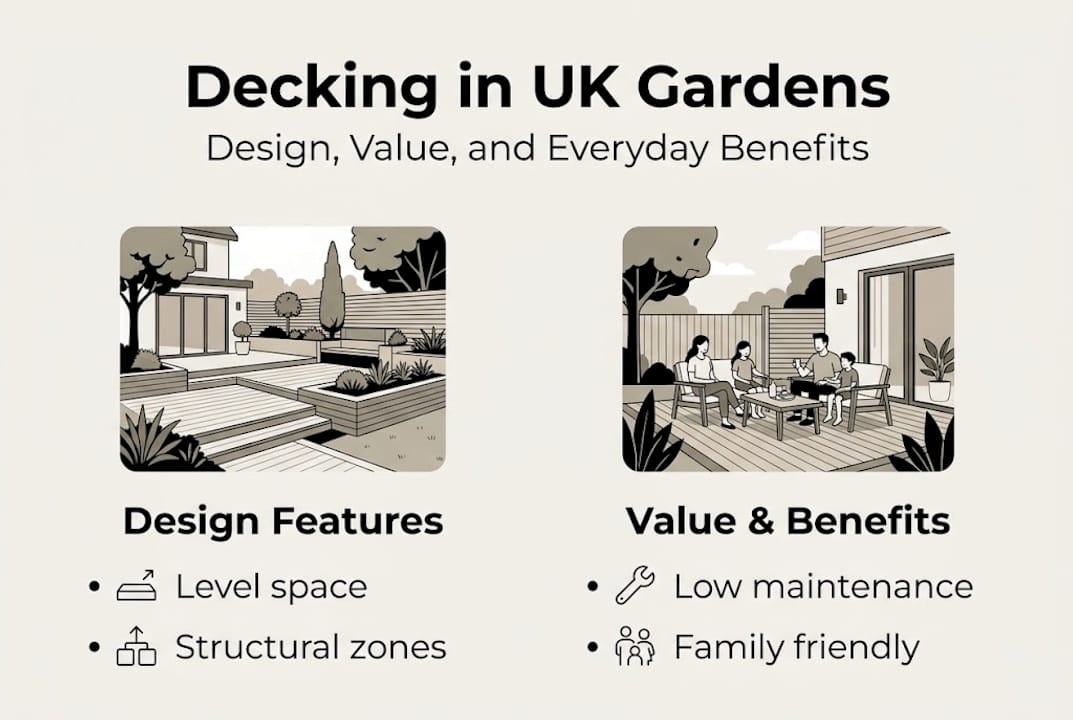
- Creates defined zones for dining, lounging, and play without fencing everything off
- Solves drainage and gradient problems on sloping plots that would be expensive to regrade
- Extends the feeling of interior space outward, making smaller homes feel larger
- Integrates with pathways, planters, and water features to build a coherent garden layout
- Provides a year-round hard surface that remains usable even after rain
The lasting impact of decking on a garden’s layout is often underestimated until you see a before-and-after comparison. A flat expanse of lawn with no levels becomes a multi-zone outdoor room. A steep garden that previously felt unusable becomes a sequence of terraced spaces connected by steps.
Worth noting: Decking also shapes the mood of a garden. Wide, pale boards in a contemporary style feel open and calm. Darker, narrow boards with built-in planters feel structured and formal. These are not surface-level choices. They define how the space feels to live in.
The role of decking in outdoor living has expanded significantly over recent years as more UK homeowners invest in their gardens as genuine extensions of their homes rather than maintenance tasks. Decking is central to that shift.
Choosing decking materials: Composite vs timber
Once you understand what decking can do for your garden, the next decision is what to build it from. The two main options are composite decking and traditional timber, and they are not interchangeable.
| Feature | Composite decking | Timber decking |
|---|---|---|
| Upfront cost | Higher (£40–£160/m² installed) | Lower initially |
| Maintenance | Very low, seasonal clean | Annual sanding, staining, sealing |
| Lifespan | 25+ years | 10–15 years without heavy upkeep |
| Slip resistance | Consistent, textured finish | Can become slippery when wet |
| Eco credentials | Often uses recycled materials | Depends on source certification |
| Colour stability | Stable, UV-resistant | Greys and weathers over time |
As noted by decking costs and options, composite installed costs range from £40 to £160 per square metre, but the long-term picture favours composite significantly when you factor in annual maintenance.

For busy households, composite is the more practical material. There is no annual sanding, no re-staining, and no worrying about rot. Explore the full range of eco-friendly decking options if sustainability is a priority for your project. Many composite boards are made from a mix of recycled wood fibre and reclaimed plastic, reducing the need for virgin timber.
Timber still appeals to those who want a natural feel and are happy to invest time in upkeep. Hardwoods like Ipe and Cumaru look exceptional when well-maintained. But in the British climate, where wet winters and damp springs are the norm, timber requires consistent attention to prevent premature degradation.
Pro Tip: If you are comparing products for long-term use, read the decking boards durability guide before committing. The construction of the board, hollow vs solid core, groove depth, and capping quality all affect how well it performs after a decade.
Key considerations when choosing your material:
- Climate exposure: North-facing or shaded decks stay wetter for longer, favouring composite
- Budget: Composite costs more upfront but less across two decades
- Aesthetics: Both materials offer wide style ranges, so neither is inherently more attractive
- Installation complexity: Composite typically requires specific fixings and closer joist spacing
Building for durability and safety: The standards you must know
Choosing a material is only part of the decision. How your deck is built determines whether it is safe, legal, and long-lasting. UK standards are specific and non-negotiable.
Here is what you need to know before breaking ground:
- Building control approval may be required if your deck is raised more than 300mm above ground level
- Handrails are legally required for decks raised above 600mm
- Neighbours and privacy can trigger planning considerations, especially in conservation areas
- Insurance implications are real: an unlicensed structure can void your home insurance policy
- Load capacity must meet UK residential standards of 1.5kN per square metre for safe use
On the structural side, installation precision matters enormously. Joists at 400mm centres, a 1:80 gradient for water drainage, and a 5–6mm expansion gap between boards are all standard installation requirements that must be met.
| Structural element | Standard requirement |
|---|---|
| Joist spacing | 400mm centres (300mm for composite) |
| Drainage gradient | 1:80 slope away from the house |
| Board expansion gap | 5–6mm between boards |
| Load capacity | Minimum 1.5kN/m² |
| Raised deck threshold | Building control above 300mm |
Pro Tip: Composite boards generally need joists at 300mm centres rather than the 400mm standard used for timber. Check the manufacturer’s specification before purchasing your subframe materials, not after.
For a thorough breakdown of what the rules mean in practice, the UK decking regulations guide is the clearest resource available. Missing these requirements is not just a bureaucratic problem. It leads to structural failure, costly remediation work, and potential safety risks for everyone who uses the space.
Maximising value: Decking as an investment in your home
Decking is not just a lifestyle upgrade. It is a financial decision, and the numbers are worth understanding clearly before you commit to any material.
Over a 25-year period, a 20m² composite deck typically costs between £3,500 and £6,000 total, including initial installation and ongoing maintenance. The equivalent timber deck can cost between £8,000 and £16,000 over the same period once you account for regular treatments, board replacements, and professional refinishing.
That is a meaningful difference. And it does not factor in the stress of annual maintenance or the disruption of replacing rotted boards.
Cost comparison over 25 years (20m² deck):
Composite: £3,500–£6,000 | Timber: £8,000–£16,000
Beyond the financial case, decking adds genuine appeal to prospective buyers. Outdoor living space is consistently cited as a priority for UK home buyers, particularly post-2020 when the value of functional garden space became undeniable.
Design choices compound this value further:
- Multi-level decking creates visual interest and separates garden zones without walls
- Built-in planters soften the structure and integrate it with the wider garden design, as shown in these composite deck planter ideas
- Integrated lighting extends the usable hours of the deck into the evening
- Colour coordination with the home’s exterior creates a cohesive, considered look
For inspiration on how high-quality decking can elevate a garden’s overall appeal, these examples of decking designs for premium gardens show what is possible across different styles and budgets. The key is treating your deck as a permanent room rather than a temporary feature.
Avoid the most common pitfalls: ignoring drainage during installation, skipping building control approval, or choosing the cheapest fixings available. Each one creates problems that cost significantly more to fix later than they would have to address from the start.
Our perspective: The hidden pitfalls and real opportunities of decking in landscaping
After years of working with homeowners across the UK, the most common regret we hear is not about the decking material itself. It is about the planning that came before it.
Homeowners focus on colour samples and board widths while overlooking drainage gradients and joist quality. Then the first wet winter arrives and the problems begin. Water pools where it should not. Boards shift. The subframe, built to the wrong spec, begins to deteriorate before the boards show a single scratch.
Composite decking is not simply a trendy alternative to timber. It is an engineering choice that suits the British climate better in most situations. It does not swell, rot, or splinter. It holds its colour without annual treatment. Most guides present this as a preference. We see it as a practical conclusion drawn from understanding how our weather actually behaves across a decade.
The other missed opportunity is zone planning. Most homeowners add a deck and then try to fit their lifestyle into it. The smarter approach is to plan for how you genuinely use your outdoor space and design the deck around those zones from day one. A separate eating area, a space for children, and a planting border are not complicated additions. They just require being decided before the first joist goes in.
Discover the right decking solutions for your garden
If this guide has helped clarify what your garden project actually needs, the next step is matching that knowledge to the right products and resources.

At Deckkingdom, we supply weatherproof composite decking built for British conditions, alongside everything you need to install it correctly. Browse composite decking accessories to find the fixings, trims, and finishing pieces that complete a professional result. If you prefer to see how installation works before committing, the step-by-step fit decking tutorial walks you through the full process clearly. And if you are still choosing your boards, the guide to weatherproof decking for UK gardens helps you match the right product to your specific conditions. Free samples are available, so you can see and feel the quality before you buy.
Frequently asked questions
Is composite decking worth the extra upfront cost?
Yes. Composite over 25 years costs £3,500–£6,000 for a 20m² deck compared to £8,000–£16,000 for timber, making it significantly more economical long-term despite the higher initial price.
Do I need planning permission for a new deck in the UK?
You may. Raised decks over 300mm require building control approval, and privacy or conservation area rules can also apply, so always check with your local authority before starting work.
How often should I clean composite decking?
Clean composite decking seasonally using mild soap and water to prevent moss, debris, and staining from building up, keeping the surface safe and looking its best throughout the year.
What is the standard load capacity for UK residential decks?
UK residential decks must support a minimum of 1.5kN per square metre, as required by current building standards for safe residential outdoor structures.

One Response